

Books
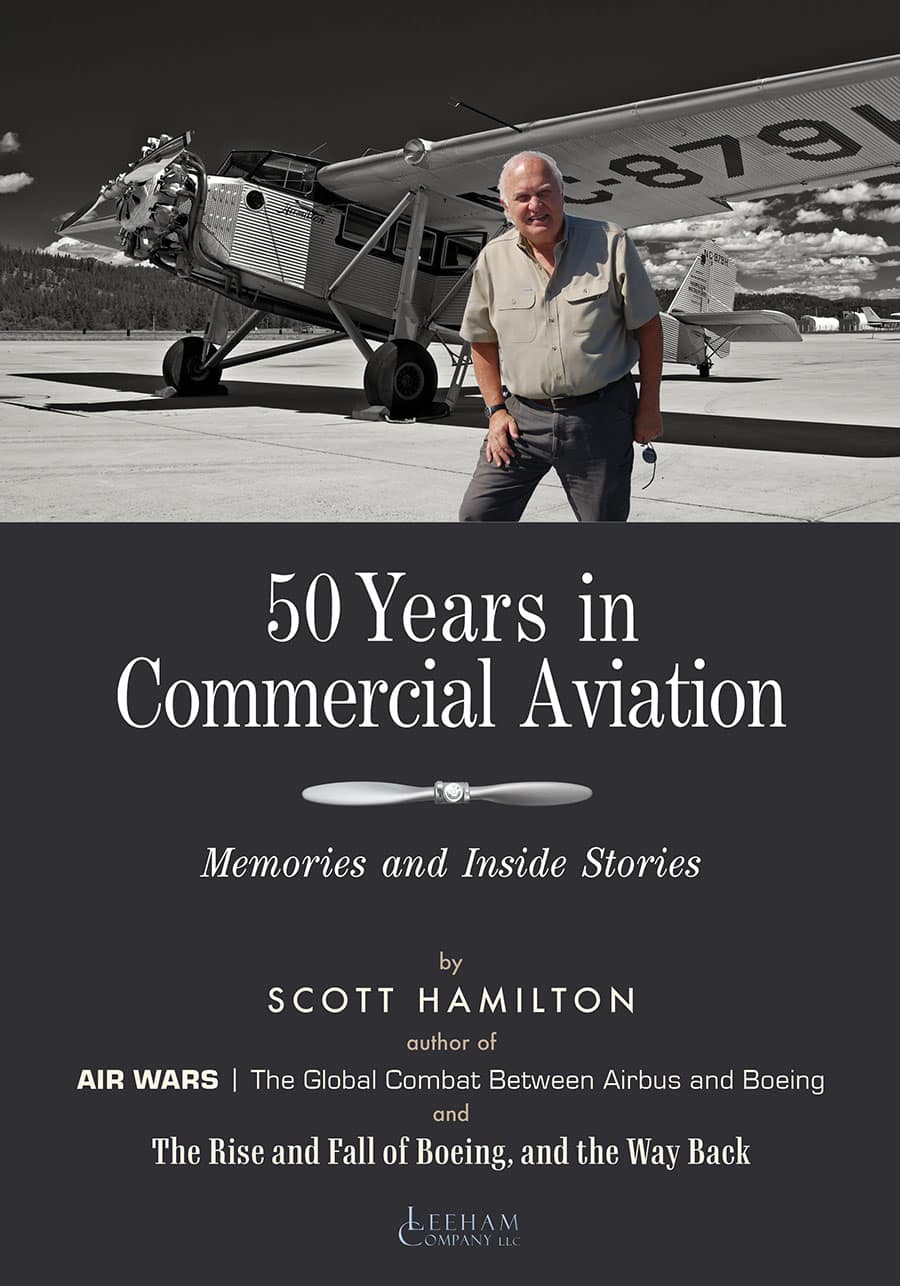
50 Years in Commercial Aviation, Memories and Inside Stories
In 50 Years in Commercial Aviation, Memories and Inside Stories,” Scott Hamilton reveals how he became infatuated with the airline industry. This led to a journalistic career that began to shift in focus from general assignments and political reporting to joining the first airline to be certified by the Civil Aeronautics Board for scheduled service in 40 years.
His career working for airlines was rather short. But he returned to journalism writing about the airline industry, and later, Airbus, Boeing and the related manufacturers and supply chain. By the time he retires from aviation journalism next year, he will have spent 50 years affiliated with this dynamic business.
50 Years includes personal stories, stories about the airlines never told before, many including his experiences, and battles he fought as an aviation journalist. Pursuing information from the Federal Aviation Administration became a federal case. Reporting on the final failure of Pan American World Airways put him on a path of conflict with Delta Air Lines. Diving deep into aircraft transactions and the financial conditions of the second Braniff Airways resulted in learning information that gave pause to potential lenders, leading to the collapse of the airline.
Hamilton tells his stories of conflicts with Airbus and Boeing; how Mitsubishi and Bombardier missed opportunities for a global presence; and diversions into personal, non-business events that are part of who he is and what helped shape his writings.
Reviews
Scott Hamilton’s memoir is a soaring and scintillating flight through five decades of aviation history. It is honest and insightful, poignant and prophetic, fun and sometimes even frightening. Hamilton’s career as both participant and journalist, insider and outsider, offers a unique perspective on commercial aviation, and the book delivers an important account of mistakes and misadventures. Most of all, Hamilton offers a revealing biography of key personalities in aviation history. His story makes clear one important aviation truth: The more things change, the more they stay the same. – Scott McCartney, Host, “Airlines Confidential” podcast and teacher of commercial aviation history at the University of Colorado’s EMBA in aviation program.
Scott Hamilton is an old-school, pull-no-punches journalist with a capital “J” who just happens to cover his passion: commercial aviation. Over 50 years covering the industry, he has had a front-row seat and remarkable access to what’s really going on behind the curtain of the airlines, OEMs, suppliers, propulsion systems, and their executives. His follow-up to “Air Wars” and “Rise and Fall of Boeing” is a trove of untold stories of this ever-shifting industry and the inner workings of how businesses truly operate now and where they’re heading in the future. Whether you’re an industry professional or an enthusiast, this is a book you won’t only be unable to put down, but one you’ll want to read again. Along the way, Hamilton takes us on diversions into his colorful, adventurous life, showing he plays just as hard as he works. – Chris Sloan, Aviation Historian

The Rise and Fall of Boeing, And The Way Back.
Scott Hamilton’s sequel to Air Wars, The Rise and Fall of Boeing and the Way Back is a deep-dive into the history of how Boeing vanquished competitors to become the world’s leading airliner manufacturer—and then squandered its position and descended into one crisis after another. Four years in the making, Rise and Fall begins with Boeing’s creation in 1916, describing how it designed the advanced Model 247 airliner and blew its opportunity to the Douglas Aircraft Co. Following World War II, Boeing nearly repeated this mistake with the leading Boeing 707, recovering by creating a broad family of airplanes. Boeing overtook Douglas and beat back an effort by Lockheed to re-enter the airliner field with the L-1011 TriStar jet. But Boeing misjudged the threat by Airbus beginning in 1974.
Conventional wisdom says that Boeing’s decline started with the 1997 merger with McDonnell Douglas Corp. and the emphasis on shareholder value. In truth, “shareholder value” was introduced before the merger. Rise and Fall reveals how shareholder value pre-dated the merger, and it describes “legacy” Boeing’s last hurrah, the original 777. The book takes the reader through the leadership eras of Phil Condit, Harry Stonecipher, Jim McNerney, Dennis Muilenburg, David Calhoun, and the beginning of Kelly Ortberg.
Reviews
Scott Hamilton is the consummate aviation storyteller. He relies on an extensive network of contacts made up of Boeing employees as well as its closely watching customers, competitors and suppliers to probe for details, insight, and perspective. Boeing is one of the few 100-year-old companies operating under its original founding name. Scott examines the changes in Boeing’s culture and questions the roles that leadership could or should have taken during the company’s crises. A gripping read for the student of business or an aviation enthusiast. – John Feren, retired McDonnell Douglas/Boeing executive.
The detail will pull you in, to a book you can’t put down. Scott was one of my key “go-to” experts on Boeing and the aviation industry during my nearly 36 years covering Boeing and aviation at KING-TV in Seattle. Reading this book is re-living that history and a lot more. His insights are as sharp as ever. – Glenn Farley, Aviation Reporter, KING-TV, NBC, Seattle.
As a follow-up to Air Wars, Scott Hamilton’s latest book delivers a well-informed and detailed account of Boeing’s rise as a national champion, its cultural shift toward shareholder value, how that strategy went awry, and whether the company can reclaim its former stature and regain the trust of key stakeholders. It’s an excellent read and a compelling case study for business leaders, analysts, and anyone following the aerospace industry. – Scott Mikus, Director of Aerospace & Defense Research at Melius Research

Air Wars: The Global Combat Between Airbus and Boeing
Scott Hamilton wrote Air Wars: The Global Combat Between Airbus and Boeing, Untold stories reveal the man and the strategies that changed aviation, in 2021. Interviews with key people from Airbus, Boeing, their customers and relying on his own decades of reporting, consulting and industry involvement, Air Wars covers 35 years of critical changes as Airbus moved up from a small competitor to Boeing, McDonnell Douglas and Lockheed to overtake them all and become the largest commercial airplane manufacturer in the world.
Air Wars was rated top buys by the Royal Aeronautical Society, the Puget Sound Business Journal, and others.
Reviews
Chris – ★★★★★
“Scott has written a lively and candid successor to ‘The Sporty Game.’ His breadth of access to industry luminaries, who spoke so candidly, really made this book. The inside story of the Boeing vs. Airbus games of chess reads like ‘The Queen’s Gambit’ but also ‘Lord of the Flies.’ The stakes couldn’t be higher. Air Wars is anything but a dry text. It’s a bona-fide page turner.”
Robert in Phoenix – ★★★★☆
“It’s a great book, and it is written in an interesting style, where every chapter is complete in itself. That makes it a great bedtime read, or indeed any time when you want to pick up a book and read for a limited time. I’m delighted I bought it. Quotes from real people involved are especially valuable, and the history of John Leahy is fascinating.”

Flying for Peanuts
Hamilton also contributed to Flying for Peanuts: Tough Deals, Steep Bargains, and Revolution in the Skies, by Frank Lorenzo, the former principal stockholder and CEO of Texas Air Corp. and Continental Airlines. Lorenzo’s memoirs begin with his immigrant parents and his emerging interest in the airline industry. He traces the creation of his consulting company, Lorenzo and Carney, with his colleague Robert Carney. Their first “office” was in a New York City Public Library and a pay phone. From there, they purchased control of Texas International Airlines, followed by an attempt to acquire National Airlines. After failing to buy Trans World Airlines, Texas Air Corp. purchased Continental Airlines, creating the foundation for today’s United Airlines.
Flying for Peanuts is available on Amazon.com, Barnes and Noble, and other outlets.